
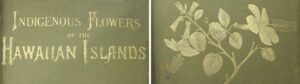
表紙

タイトル:ハワイ諸島の在来植物
44種類の植物を水彩画で描写、解説付き
著者: フランシス・シンクレア・ジュニア夫人
ロンドン:サンプソン・ロウ、マーストン、シール、アンド・リヴィントン社 1885年
艶やかな翼を持つ鳥は美しく、
夜の静寂のすべての時を貫いて
輝く星々もまた美しい。
しかし、創られしものの中で何よりも先に、
驚くべき美をもって立ち現れるのは、
花である。
ハワイの首長の方々、そして人々へ。
私にとって最も理解深い友であり、
また最も寛大な批評者であった皆さまに、
この書を深い愛情をもって捧げます。

はじめに
ハワイ諸島はこれまでに、その植物相(フローラ)の美しさを特別称えられてきた土地ではありません。実際、初めてこの地を訪れる人にとっては、在来の花がほとんど存在しないかのように感じられることさえあります。しかし、丘や平地、海岸、そして雲に包まれた山々を丹念に探してみると、そこに見いだされる花の数とその多様性には、驚かされることでしょう。ハワイ諸島には、一般に言われる意味での「野の花」は多くありませんが、花を咲かせる樹木、低木、蔓植物にはたいへん恵まれています。
本書で植物を紹介するにあたり、季節についてしばしば言及していますが、これは、ハワイ諸島が純然たる熱帯気候であり、雨季と乾季しか存在しないと考えている方々には、やや意外に思われるかもしれません。実際には、ハワイ諸島はきわめて温帯に近い気候を有しており、夏と冬、春と秋の区別もかなり明瞭です。植物の生育は寒冷地ほど季節の影響を受けるわけではありませんが、それでも冬の眠りと春の目覚めは、はっきりと感じ取ることができます。
本書に収めた花々の標本図は、ハワイ諸島の中でも最北に位置するカウアイ島およびニイハウ島において採集されたものです。自然学者によれば、ハワイ諸島に自生する開花植物は四百種以上に及ぶとされていますが、本書に収めた標本群は、その数に比して決して大規模なものではありません。ただし、この植物数の調査は数年前に行われたものであり、その後すでに姿を消した植物も少なくないと考えられます。
ハワイのフローラは、在来の人々同様に、どこか無造作で、のびやかな様相を呈しています。その姿は芸術的であり、島々のいわば自然の状態にはよく調和していますが、外来植物の侵入や環境条件の変化に、長く耐えうるものではありません。過去五十年から六十年の間に、森林火災、動物、人間による農業活動などによって島々の環境は大きく変化しました。その結果、地域によっては何マイル移動しても在来植物を一つも見つけることができず、土地の大半が、さまざまな国から持ち込まれた雑草、低木、牧草類によって占められている状況も見られます。注目すべきことに、熱帯由来の植物と温帯由来の植物の双方が、これらの島々では等しくよく繁茂しています。その多くは、まるで魔法のような勢いで広がり、在来植物の多くを急速に駆逐しているのです。
各植物の生育地(ハビタット)については、厳密な定義を行うことが困難です。低地性の植物が山地で見つかったり、山地性の植物が海岸で見つかったりすることも、しばしばあります。ただし、一般的な傾向としては、本書で示した生育地は概ね正確であると考えて差し支えありません。ハワイ諸島の気候は、貿易風によって大きく左右されています。そのため、温暖な低地を原産とする植物が、冷涼な貿易風から守られた高地において、快適な生育環境を見いだすこともあります。一方で、西側の温暖な地域では高く涼しい山地にのみ見られる植物が、東側の冷涼な地域では海岸近くで旺盛に育つ姿が見られることも少なくありません。
ハワイ語の植物名を記すにあたっては、できる限り正確を期しましたが、現代の一般的なハワイの人々から、たとえ比較的よく知られた植物であってもその名称を聞き出すことは、しばしば困難です。ましてや、希少な山地性の植物となると、その困難はさらに大きくなります。これは一部には植生そのものの変化によるものですが、それ以上に、人々の生活様式が大きく変化したことによる影響が大きいと考えられます。かつての人々は、現在よりもはるかに自然の事物に対して知的な関心を寄せており、ほとんどの人が島々の植物相や、それぞれの植物がもつ性質についてよく理解していました。また、当時の生活様式は、植物の研究を進めるための機会や動機を、現在よりもはるかに多く与えてくれていたのです。
古くは、そして五十年から六十年ほど前に至るまで、多くの住民が毎年のように山地へ赴いていました。その目的は、カヌーの製作、鳥の捕獲、木材の伐採、薬草の採集など、実にさまざまであり、娯楽や生計のための活動でもありました。しかし近年では、かつての健やかで勤勉な生活様式が大きく変わり、そのような遠征が行われることは、きわめて稀になっています。その結果、現代の人々の居住地から遠く離れた場所を生育地とする植物について、信頼できる情報を得ることができるのは、年配の人々からのみであり、しかも、その中でさえわずかな人数に限られてしまっています。
ハワイ語の植物名に関するもう一つの困難は、文字による記録をもたなかったすべての民族に共通する問題でもありますが、同じ植物が地域によって異なる名前で呼ばれていることです。ハワイ語が文字として定着したのは、ほんの五十年ほど前のことに過ぎません。しかし、それらの植物は、それぞれに結びついた物語や民間伝承の類似性によって、島々全体を通して辿ることができる場合が多くあります。そして、それらの神話は数多く、しかも優美で、きわめて古い時代から、世代を超えて語り継がれてきたものと思われます。
ハワイの人々は、太平洋の各地に広がる同じ民族の人々と同様に、自然の美に対して驚くほど深く、そして強い愛情を抱いています。花のもつ美しさや、繊細で言葉にしがたい魅力を、これほどまでに敏感に感じ取る人々は、今まさに姿を消しつつある世代の、素朴なハワイの人々以外には、ほとんど見いだすことができません。熱帯地方で花の絵を描いた経験をもつ者でなければ、満足のいく写生を行うことが、いかに困難であるかを知ることはできないでしょう。その困難は、花の多くがきわめて繊細であること、そして気候の暑さによって、いっそう繊細さは大きなものとなります。多くの花は採集された直後から急速にしおれ、温帯地方の花々よりもはるかに早く衰えてしまいます。そのため、最大限の迅速さが求められますが、このような状況は、決して絵画制作に理想的とは言えません。
しかし、こうした多くの困難にもかかわらず、本書を読むことで得られる喜びが、その制作過程において私自身が味わった喜びと同じほどのものであるならば、あるいは、これをきっかけとして、同じ広く魅力的な研究に取り組む人が現れるならば、著者の目的は十分に達成されたと言えるでしょう。
イザベラ・シンクレア ー カウアイ島 マカウェリにて
1884年5月
追記:本書における植物学名については、ジョセフ・D・フッカー卿のご厚意とご親切に負うところが大きいことを、ここに記して感謝の意を表します。ロンドン、1885年2月 I. S.
「はじめに」の原文(英語)を読む
INTRODUCTION.
The Hawaiian Islands have never been celebrated for the beauty of their flora. Indeed, to a stranger, they almost seem destitute of indigenous flowers. But when one comes to search, on hill and plain, sea-coast and cloud-enveloped mountain, it is astonishing the number and variety that are to be found. The islands do not possess many field flowers — in the usual acceptation of the term— but they are rich in flowering trees, shrubs, and vines.
In describing the plants, the seasons are often mentioned. This may be a little confusing to those who are under the impression that the islands possess altogether a tropical climate, with simply a wet and dry season. On the contrary, they enjoy so nearly a temperate climate, that summer and winter, spring and autumn, are pretty distinctly marked. And although plant-life is not nearly so much affected by the seasons, as in colder climates, yet the sleep of winter, and the awakening of spring, are quite apparent.
The following collection of flowers was made upon the islands of Kauai and Niihau, the most northern of the Hawaiian Archipelago. It is not by any means a large collection, considering that the flowering plants of the islands are said by naturalists to exceed four hundred varieties. But this enumeration was made some years ago, and it is probable that many plants have become extinct since then.
The Hawaiian flora seems (like the native human inhabitant) to grow in an easy careless way, which, though pleasingly artistic, and well adapted to what may be termed the natural state of the islands, will not long survive the invasion of foreign plants, and changed conditions. Forest fires, animals, and agriculture, have
so changed the islands, within the last fifty or sixty years, that one can now travel for miles, in some districts, without finding a single indigenous plant ; the ground being wholly taken possession of by weeds, shrubs, and grasses, imported from various countries. It is remarkable that plants from both tropical and temperate regions seem to thrive equally well on these islands, many of them spreading as if by magic, and rapidly exterminating much of the native flora.
It is only possible to give an approximate definition of the habitat of the various plants ; as it often happens, that a lowland plant is found on the mountains, or a mountain plant is found on the coast ; but, as a general rule, the habitat given will be found fairly correct. The climate of the islands is greatly modified by the trade-winds. Consequently, plants which are natives of the warm lowlands, may sometimes find a congenial abode at a high elevation, in localities that are sheltered from these cool bracing winds. On the other hand, plants, which are only found on the high cool mountains on the western, warm side of the islands, are often found flourishing near the coast on the eastern, cool side.
In giving the Hawaiian names, great care has been taken to be strictly accurate; but it is often difficult to learn from the ordinary native of the present day, the names of even comparatively common plants, and doubly so with regard to the rarer mountain species. This is partly owing to the changing vegetation, but much more so to the changed habits of the people themselves. Formerly they took a much more intelligent interest in natural objects than they do now, and were nearly all well acquainted with the flora of the islands, and the properties of the various plants, while their former modes of life afforded them many more opportunities and inducements to pursue the study.
In olden times, and even to within the last fifty or sixty years, great numbers of the inhabitants went into the mountain districts annually, for various purposes, such as canoe-making, bird-catching, wood-cutting, gathering medicinal herbs, and many other pursuits of pleasure or profit. But of late years the old, healthful, industrious life has so changed, that it is now very seldom they make such expeditions. Consequently it is only from old people — and few even of them — that any reliable information can be obtained, regarding plants which have their habitat far from the abodes of the people of the present generation.
Another difficulty with Hawaiian names, — a difficulty common to all nations without a written language (it was only about fifty years ago that the language was reduced to writing) — is that many plants are known by different names in different districts. But they can generally be traced throughout the islands by a similarity of story and folk-lore connected with each ; and many and graceful are these myths, handed down from generation to generation, seemingly from very ancient times.
The Hawaiians, like all their race throughout the Pacific, have a most wonderful and intense love of the beauties of nature. Seldom is there found any one more appreciative of the beauty and subtile charm of flowers, than the simple Hawaiian of a generation that is fast passing away.None can know, save those who have painted flowers in the tropics, the difficulties encountered in obtaining a satisfactory representation, owing to the fragile nature of most of the flowers, and also to the heat of the climate. Many of the flowers fade immediately after they are gathered, and all decay very much sooner than those of temperate climates ; thus rendering the utmost expedition necessary — a state of things by no means conducive to the successful execution of the paintings.
However, notwithstanding the difficulties encountered, if the perusal of the present work should give as much pleasure as its production has given ; or, if it lead others to take up the same wide and delightful study, the author’s object will be fully accomplished.
Isabella Sinclair. Makaweli, Kauai. May , 1884 ..
The Author is indebted to the courtesy and kindness of Sir Joseph D. Hooker for the botanical names of the plants. London, February , 1885. I. S.


コメント